
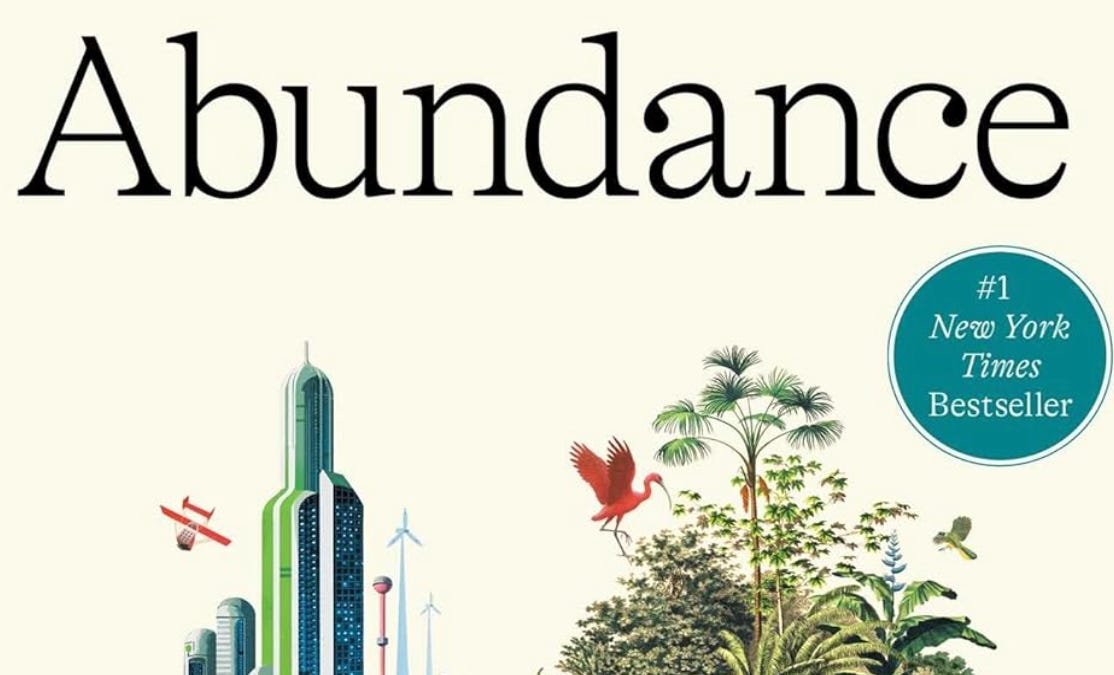

The California housing crisis is a choice, and Ezra Klein and Derek Thompson’s Abundance documents how the state made it. On Politechly, I collected the book’s passages on California and Los Angeles, reading as a center-right reader who wondered whether my own priors were leading me astray, and what the two progressives documented was a real eye-opener.
Their case rests on supply, starting with the authors’ count that California routinely built more than 200,000 homes a year in the 1950s and 1960s and hasn’t permitted 150,000 in any year since 2007. They trace the state’s turn from welcoming growth to capping it and describe how environmental review under CEQA, the state’s environmental quality law, became a tool for litigating housing projects to death. They also show how loading each project with requirements, the “everything-bagel” approach, adds costs at every step, down to the consultants hired to confirm a building met the standard.
Los Angeles is the sharpest example, with its metro area permitting 2.5 homes per 1,000 residents against 18 in Austin. A 2022 audit, as the authors report, put the cost of units funded by Proposition HHH, the $1.2 billion housing bond city voters approved in 2016, at about $600,000 each, nearly twice the median home price in Houston. Austin, which I also cite in AI Regulation Needs a Light Hand, shows the alternative, since rents there fell as the city permitted more housing.
The full piece is on Politechly: Abundance and California’s High Cost of Housing.
This article was produced in part with AI, see my disclosure here.